

English
At Crosslee Primary, our intention is to ensure that every pupil develops the secure foundational knowledge, skills and understanding needed to become confident communicators, readers and writers. We believe that strong foundations in English are essential for success across the curriculum and beyond, and we are committed to providing a rich, ambitious and carefully sequenced English curriculum that enables all pupils to thrive.
We aim for every child to experience a well-rounded English education—one that nurtures accuracy, fluency, creativity and a lifelong love of language. Through high-quality teaching of reading, writing, speaking and listening, pupils gain the fundamental tools they need to achieve in the academy and in later life. Our Book-Led curriculum immerses children in high-quality texts, exposing them to diverse voices, rich vocabulary and meaningful themes that inspire curiosity and enjoyment.
Early Reading and Phonics
A strong start in reading is central to our approach. The first step in helping children become confident, fluent readers is ensuring they secure the foundational skills of decoding, blending and segmenting. At Crosslee, early reading begins in Nursery and continues throughout school, following the systematic and rigorous Read Write Inc. phonics programme.
-
Children learn phonics through daily, high-quality teaching that builds knowledge cumulatively and securely.
-
Sounds are taught in a clear progression across three sets, enabling pupils to develop accuracy and automaticity.
-
At the end of Year 1, all pupils complete the Phonics Screening Check, which helps us identify children who may need additional support.
-
Pupils who require further practice receive targeted intervention, including Hi-Lo reading support, ensuring that no child is left behind.
-
Children take home books that are carefully matched to their phonics stage, helping them consolidate learning and build confidence.
We strongly encourage families to support reading at home. The links below provide guidance and resources to help parents engage with phonics and early reading.

Reading for Pleasure and Comprehension
Alongside phonics, pupils develop comprehension skills through daily reading lessons. These lessons build the foundational strategies needed to understand, interpret and enjoy a wide range of texts. We want every child to read widely and for pleasure, developing both knowledge and imagination.
reading for pleasure at crosslee community primary school.pdf
Spelling, Punctuation and Grammar (SPaG)
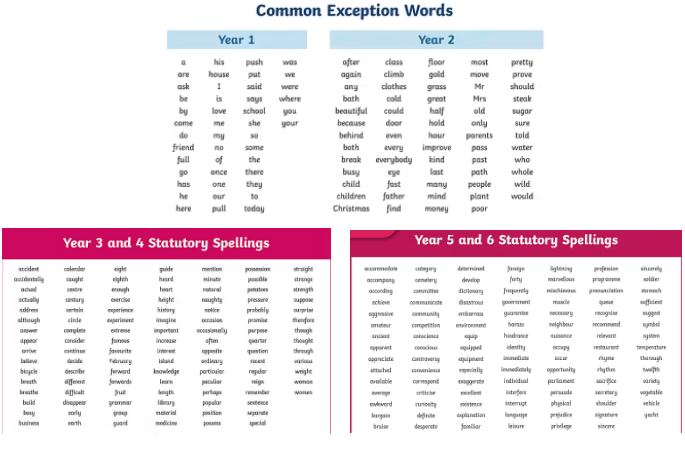
A secure foundation in spelling, punctuation and grammar underpins pupils’ ability to write with accuracy and confidence. SPaG is taught explicitly and progressively across the school:
-
From Year 2–6, pupils follow the No Nonsense Spelling programme.
-
In EYFS and Year 1, spelling is embedded within Read Write Inc. sessions.
-
SPaG knowledge is continually reinforced through reading and writing across the curriculum.
This structured approach ensures that pupils build strong foundational skills that support increasingly sophisticated writing as they move through school.
Writing:
Nursery: Early Writing Development
Writing begins with a strong focus on physical development and early mark‑making. Children are immersed in a language‑rich environment where they explore a wide range of materials that encourage purposeful marks. This includes:
-
Mark‑making across continuous provision: Children access varied tools (crayons, chalks, paintbrushes, natural materials) to experiment with lines, shapes, patterns, and symbols. Provision is designed to promote curiosity, fine‑motor development, and early understanding that marks carry meaning.
-
Gross‑ and fine‑motor strengthening: Activities such as threading, dough work, large‑scale painting, and outdoor movement support the muscle development needed for later writing fluency.
-
‘Squiggle While You Wiggle’ intervention: This structured programme develops the physical foundations of writing through rhythmic movement, dance, and pattern formation. Children learn to translate large‑scale movements into controlled, smaller marks, building coordination, stamina, and confidence. Sessions link movement to early letter formation patterns, preparing children for more formal writing in Reception.
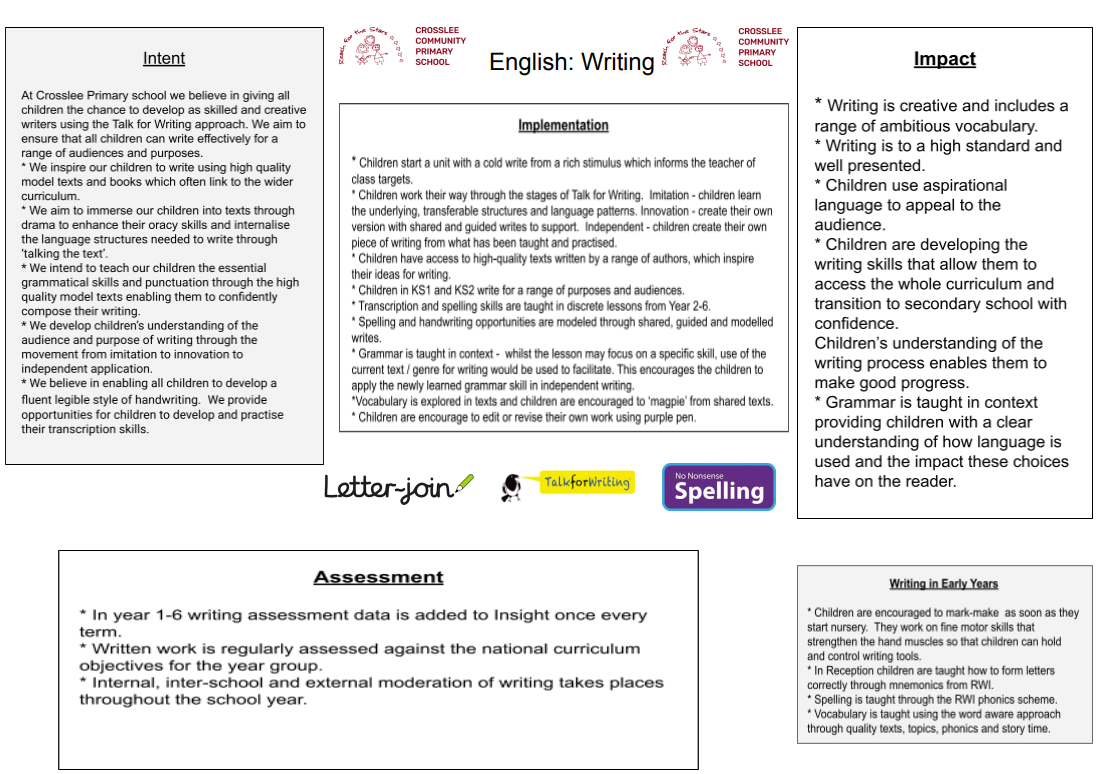
Across Key Stage 1 to Year 6, writing is taught through the Talk for Writing approach, ensuring consistency, progression, and high‑quality outcomes. This includes:
-
Imitation phase: Pupils internalise language patterns through oral storytelling, text mapping, drama, and shared reading. They develop a deep understanding of text structure, vocabulary, and authorial techniques.
-
Innovation phase: Children adapt the model text, experimenting with changes to characters, settings, events, or information. This phase builds confidence, creativity, and control over writing choices while maintaining secure structure.
-
Independent application: Pupils apply their learning to produce independent pieces across a range of genres. They draw on taught grammar, vocabulary, and structural features to craft coherent, purposeful writing.
-
Progression and challenge: As pupils move through the school, texts increase in complexity, and expectations for vocabulary, cohesion, stamina, and authorial voice deepen. Grammar and punctuation are taught explicitly and embedded within meaningful writing contexts.
-
Consistency and shared pedagogy: The approach ensures a common language for teaching writing, clear modelling, and structured scaffolding. This supports all learners, including those with SEND, to access high‑quality writing instruction.
Handwriting
Fluent, legible handwriting is another essential foundation for effective communication. At Crosslee, we teach handwriting systematically from Nursery to Year 6:
-
Early years focus on pencil grip, fine motor development and correct letter formation.
-
As pupils progress, they learn to join letters and develop a consistent, fluent style.
-
By Year 6, pupils refine their handwriting to ensure it is efficient, neat and ready for secondary expectations.
We use letter join to teach handwriting from Reception to Year 6.
Letter join at home- Click here